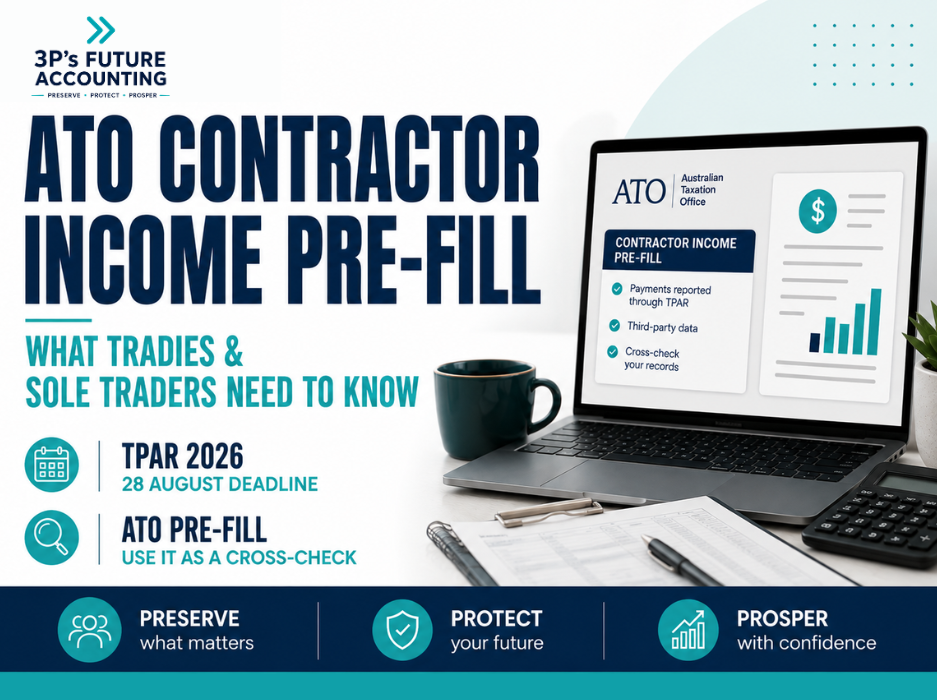
The ATO Can Now Pre-Fill Contractor Income: What Tradies and Sole Traders Need to Know

Updated: Aug 19
Why Taxable Payments Annual Report data matters for both businesses that pay contractors and the contractors whose income is being reported.
Written by: Melissa Cunliffe (CA)
The ATO has another source of contractor-income data
For contractors and sole traders, tax return preparation is increasingly a reconciliation exercise rather than a blank form. The ATO receives information from banks, employers, investment providers and a growing number of third parties. Taxable Payments Annual Reports—TPARs—are an important part of that system for many contracting industries.
Businesses in specified industries may need to report payments made to contractors for relevant services. TPARs are generally due by 28 August each year. The ATO uses reported payment information to support compliance activity and to place contractor-income information into eligible online tax returns.
Two audiences, one dataset
If you pay contractors, accuracy in the TPAR matters because the information can flow into the contractor’s ATO records. If you are the contractor, the pre-fill is a useful cross-check—but it does not replace your own bookkeeping or determine your taxable profit.
Who may need to lodge a TPAR?
TPAR obligations can apply to businesses that provide particular services and pay contractors to perform those services on their behalf. Relevant categories include building and construction services, cleaning services, courier services, road freight services, information technology services, and security, investigation or surveillance services. Government entities also have reporting obligations for certain payments.
The detailed tests vary by industry, including rules where the relevant services are only one part of the business. Businesses should not assume they are outside the regime simply because they are not primarily known as a construction, cleaning or courier business.
The 28 August deadline matters
TPARs are generally due by 28 August following the end of the financial year. That timing matters for contractors because payer-reported information may not be complete in the ATO pre-fill system earlier in tax season. Lodging before all third-party information arrives can increase the risk that income is omitted and the return later needs to be amended.
Pre-filled income is not the same as taxable profit
This is one of the most important distinctions for contractors. A payer may report gross payments for services. Your taxable business profit is worked out after applying the tax law to your assessable income and allowable deductions. Legitimate costs such as materials, subcontractors, insurance, tools, vehicle expenses, software and other business expenses may reduce taxable profit where the deduction requirements are satisfied and records are kept.
Pre-fill should therefore be treated as a cross-check. It is not a substitute for invoices, bank reconciliation, accounting software or a properly prepared business schedule.
What if the ATO figure does not match your books?
Check whether the payer reported amounts on a cash or payment basis that differs from the way you are viewing sales in your accounting software.
Check GST treatment. A reported gross payment figure may need to be understood before it is compared with income recorded net of GST.
Look for duplicated or incorrect payer reports, including situations where a business name, ABN or payment was reported incorrectly.
Check invoices around 30 June for timing differences and confirm whether the amounts were actually paid in the relevant year.
Reconcile all business bank accounts and ensure private transfers, loans and owner contributions have not been incorrectly classified as business income.
Do not simply delete a pre-filled amount because it is inconvenient. Investigate and document the reason for the difference.
If your business pays contractors
Good TPAR reporting begins with good supplier records. Check ABNs, names and GST registration where relevant. Code contractor payments consistently and review the report before lodgment. An incorrect TPAR can create confusion for the contractor and can also expose weaknesses in the payer's own records.
If you are a contractor or sole trader
Do not rely only on ATO pre-fill. Some clients may not have a reporting obligation, some payer information may arrive later, and not every type of business receipt appears through TPAR. You remain responsible for declaring all assessable income.
Five records to reconcile before lodging
Accounting-software sales and income reports for the financial year.
Business bank and payment-platform receipts.
Issued invoices and year-end debtors or unpaid invoices.
ATO pre-fill and any TPAR-related information available through your tax agent or online services.
GST and BAS records so gross and net figures are compared on a consistent basis.
A note on contractor status
TPAR does not decide whether a worker is legally an employee or independent contractor. Worker classification depends on the legal relationship and the actual terms and operation of the arrangement. Superannuation, PAYG withholding, workers compensation and Fair Work obligations can still arise even where someone invoices under an ABN. Businesses engaging workers should review classification separately.
Preserve, Protect, Prosper
At 3P's Future Accounting, we can reconcile contractor income, review TPAR obligations and make sure the tax return, BAS and bookkeeping records tell the same story. That helps Protect against avoidable data-matching problems, Preserve every legitimate deduction and Prosper with clean financial information that can also support pricing, finance and business decisions.
Frequently asked questions
When is the TPAR due?
For businesses required to lodge, the Taxable Payments Annual Report is generally due by 28 August each year.
Who has to lodge a TPAR?
The regime applies to specified industries and certain government entities. Relevant service categories include building and construction, cleaning, courier, road freight, IT, security, investigation and surveillance, subject to detailed tests.
If income is not in ATO pre-fill, can I leave it out?
No. You are responsible for declaring all assessable business income, whether or not a third party has reported it to the ATO.
What if the TPAR pre-fill is higher than my accounting records?
Do not automatically accept or delete the figure. Reconcile timing, GST treatment, payer information, invoices and bank receipts and investigate any error.
Does a TPAR prove I am a contractor rather than an employee?
No. TPAR is a payment-reporting regime. Employment status is a separate legal and tax question based on the actual relationship.
Book a meeting with our team today to review your TPAR obligations, reconcile contractor income and ATO pre-fill data, and make sure your records are accurate, complete and ready for tax time.
Disclaimer
This article does not constitute financial advice and is for general information only. It does not take into account any individual’s personal objectives, situation or needs, and is not intended as professional advice. Any similarity to an individual’s personal circumstances and the examples provided in this article is purely coincidental. Any person acting upon such information without receiving specific advice, does so entirely at their own risk.
Authorisation under an Australian Financial Services Licence (AFSL) is not required in the provision of this article and the author plus Future Accounting Group Pty Ltd is not acting in its capacity as an Australian Financial Services Licence holder
Liability limited by a scheme approved under professional standards legislation.