
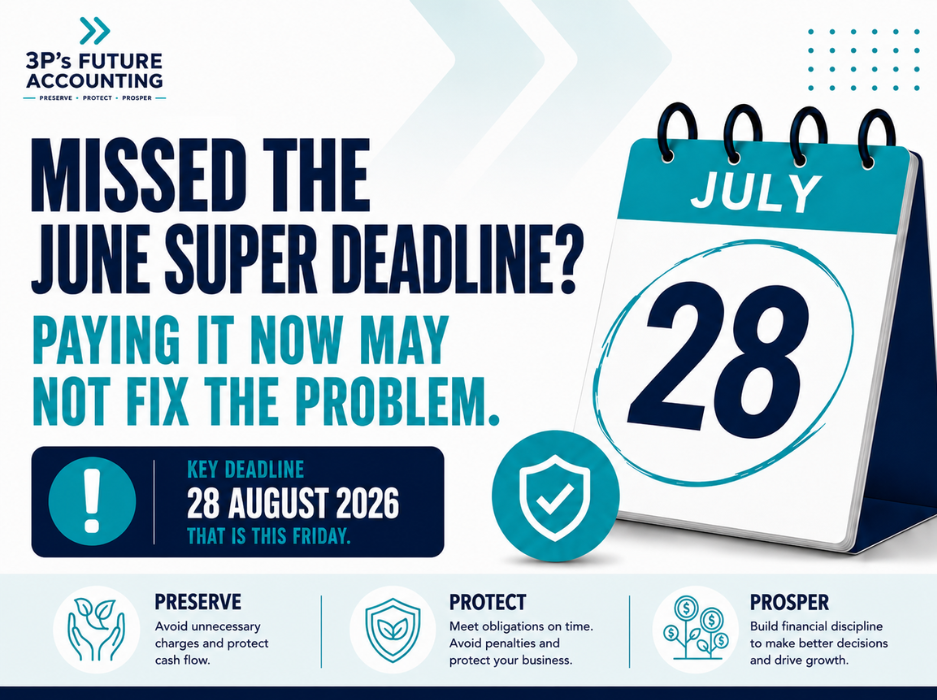
Missed the June Super Deadline? Paying It Now May Not Fix the Problem

Written by: Melissa Cunliffe (CA)
Did your employees' June-quarter super actually reach their super funds by 28 July — or did your business simply process the payment by then?
That distinction is critical.
The June Super Deadline is an important compliance date for Australian employers, particularly as it was the final quarterly superannuation deadline before Payday Super commenced.
Australian employers have now moved into Payday Super, with superannuation generally required to reach an employee's super fund within seven business days of payday from 1 July 2026.
But there is still one important piece of the old quarterly system to finish.
If an employer's super guarantee for the April to June 2026 quarter was not received by the employee's fund by 28 July 2026, the business may have a Superannuation Guarantee Charge — SGC — obligation.
And the key deadline is 28 August 2026
That is this Friday.
For affected businesses, simply paying the outstanding super now may not resolve the compliance issue.
Why the June Super Deadline Matters
The April–June 2026 quarter was the final quarter before Payday Super commenced. That creates an unusual crossover. A business may now be perfectly compliant with its August payroll and Payday Super obligations...
while still having an outstanding problem relating to June.
This can happen where:
the employer paid after 28 July;
a clearing house processed the contribution late;
employee details were incorrect;
the fund rejected the payment;
the payment was returned;
the employer changed clearing houses;
payroll records showed the amount as paid but the fund did not actually receive it in time; or
the business simply missed the deadline.
The important test is not:
“Did we press pay before 28 July?”
It is:
“Did the employee's super fund receive the required contribution by the deadline?”
What happens if it was late?
Where the quarterly super guarantee was not paid correctly and on time, an employer can become liable for the Superannuation Guarantee Charge. Historically, employers may be familiar with using late super contributions to reduce an SGC liability through the late payment offset in certain circumstances.
But for this final quarterly period before Payday Super, the ATO has specifically indicated that the usual late payment offset is not available. That makes it particularly important not to assume that making the payment after the deadline automatically cures the issue.
If affected, the employer generally needs to lodge an SGC statement and deal with the resulting liability by 28 August 2026.
Super compliance is now a cash-flow discipline
There is a much bigger lesson here.
Superannuation used to be something many businesses thought about quarterly. That mentality now needs to disappear. Under Payday Super, the expectation is much closer to payroll itself.
From 1 July 2026, employers generally need contributions to reach employees' super funds within seven business days of payday, subject to particular exceptions.
That means businesses need systems capable of:
calculating super correctly;
processing contributions promptly;
identifying rejected payments;
correcting incorrect fund details;
monitoring new employees;
reconciling payroll to super receipts; and
fixing errors quickly.
Super is no longer a quarterly clean-up exercise. It is part of every pay cycle.
The risk of relying on the payroll screen
A common mistake is assuming:
Payroll says paid = super is compliant.
Not necessarily. Money has to move through the payment system and reach the fund.
If:
an employee's USI is wrong;
their member number is incorrect;
the fund rejects the transaction;
a clearing-house payment fails; or
money is returned,
the original payroll entry does not solve the problem.
Under the faster Payday Super timetable, businesses need visibility over exceptions and rejections quickly.
Run a June-quarter reconciliation now
Before 28 August, affected employers should check the April–June quarter specifically.
For every employee, verify:
How much super was required?
When was the contribution submitted?
When did the employee's fund receive it?
Were any payments rejected or returned?
Is there any shortfall?
Do not rely solely on the general ledger. Reconcile payroll to the actual contribution outcome.
And what about BAS?
There is another immediate compliance deadline in the same week.
For eligible clients lodging through a registered BAS or tax agent, the extended due date for the June-quarter activity statement is 25 August. The BAS and super deadlines are different obligations, but the cash-flow lesson is similar.
A business should not discover tomorrow's tax liability today.
GST.
PAYG withholding.
Superannuation.
PAYG instalments.
These should be continually tracked and funded.
Imagine the business reaches BAS time and owes:
$35,000 GST;
$22,000 PAYG withholding; and
significant super contributions.
If none of that cash has been separately planned for, the business can suddenly face an enormous payment week. But those obligations did not arise overnight. They accumulated while the business traded.
That is why we encourage businesses to include tax and super in their regular cash-flow process rather than treating them as occasional compliance events.
A proactive monthly compliance process
At minimum, businesses should have a regular process covering:
Payroll
Reconcile gross wages, PAYG withholding and super.
Super
Confirm contributions actually reached employees' funds and investigate exceptions immediately.
GST
Reconcile GST collected and GST credits every month—even if the business lodges quarterly.
Tax
Maintain an estimate of PAYG instalments and income-tax liabilities.
Cash
Consider moving estimated tax and super commitments into a separate account or otherwise reserving the cash.
Deadlines
Maintain a compliance calendar that somebody in the business is specifically responsible for monitoring.
The objective is simple:
No surprises.
Preserve. Protect. Prosper.
This is a very practical example of the 3P's Future Prosperity Model.
PRESERVE
Preserve cash and wealth by avoiding unnecessary charges. Late compliance can turn an existing liability into a more expensive one. Do not allow administrative failures to consume profit that took real work to earn.
PROTECT
Protect the business by meeting employee and ATO obligations on time. Super belongs to employees. GST and PAYG need to be properly accounted for. Strong systems protect the business from penalties, interest, compliance action and reputational damage.
PROSPER
Prosper by building financial discipline into normal operations.
A business that knows its tax, super, payroll and cash commitments throughout the month can make better decisions about:
hiring;
purchasing;
drawings;
dividends;
equipment;
debt repayment; and
growth.
Compliance and good business management are not separate things. Often, they are the same discipline.
Five checks for this week
Before Friday, ask:
Did all June-quarter super reach employees' funds by 28 July?
Were any contributions rejected or refunded?
Is an SGC statement required by 28 August?
Is the June-quarter BAS lodged and funded?
Are our Payday Super processes working properly for every July and August payroll?
If you do not know the answers, check now.
The 3P's view
The transition to Payday Super changes the way employers need to think about superannuation. It is no longer something to accumulate and address at the end of each quarter.
It is part of payroll.
And the final June-quarter obligation deserves particular attention because it sits between two systems.
At 3P's Future Accounting, our message is simple:
Don't assume.
Reconcile.
Don't wait for an ATO letter.
Identify the problem first.
And don't treat tax and super as surprise expenses.
Build them into the cash-flow rhythm of the business.
Preserve. Protect. Prosper.
If you are unsure whether your June-quarter super was received on time, whether an SGC statement is required, or whether your business is ready for the ongoing requirements of Payday Super, don't leave it until the ATO comes knocking.
Book a consultation with the Future Accounting team to review your super, tax and cash-flow obligations and make sure your compliance processes are working properly.
Disclaimer
This article does not constitute financial advice and is for general information only. It does not take into account any individual’s personal objectives, situation or needs, and is not intended as professional advice. Any similarity to an individual’s personal circumstances and the examples provided in this article is purely coincidental. Any person acting upon such information without receiving specific advice, does so entirely at their own risk.
Authorisation under an Australian Financial Services Licence (AFSL) is not required in the provision of this article and the author plus Future Accounting Group Pty Ltd is not acting in its capacity as an Australian Financial Services Licence holder
Liability limited by a scheme approved under professional standards legislation.


